
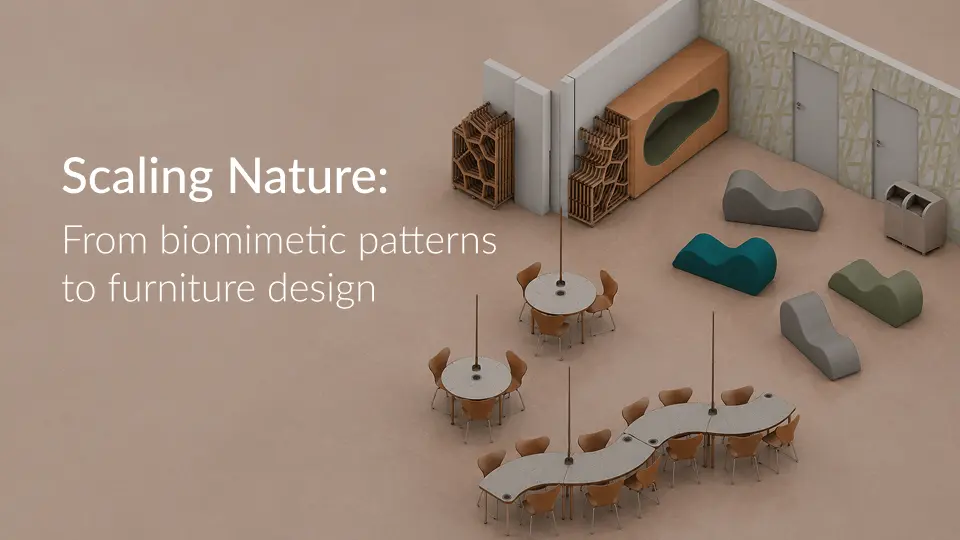
Not every script is created to solve one specific task. Sometimes it begins as an experiment and later reveals a much wider potential.
This was the case with a parametric definition developed by Ana Luisa Martins as part of the Biomimetic Design course at Fatec Tatuapé – Victor Civita. The project began with the study of natural patterns and their translation into geometric systems capable of generating textures.
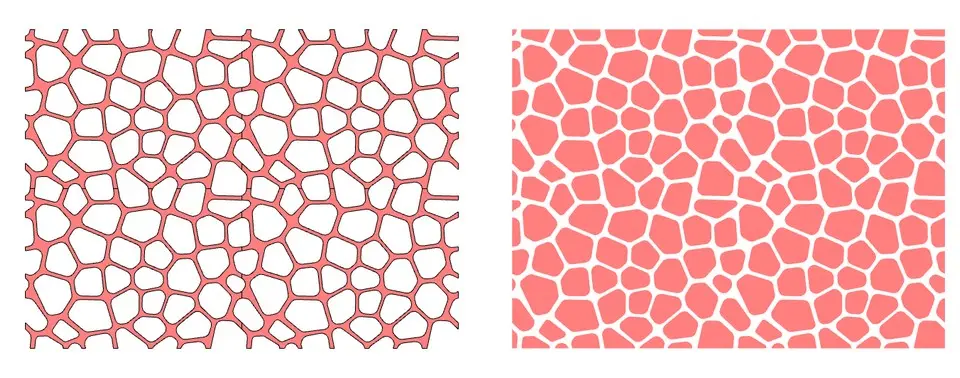
Final Voronoi texture showing openwork and filled tile variations generated from the same definition]
Natural Structures as a Source of Form
The research started with observations of natural structures: loofah fibres, bubbles, cracked soil, turtle shells, giraffe skin, and other irregular cellular organisations.
Instead of copying these forms literally, the project focused on their internal logic: porosity, uneven distribution, and organic variation.
Using Rhino and Grasshopper, Ana Luisa developed a parametric definition based on a Voronoi diagram.
A Voronoi pattern divides space into regions based on the distance to a set of seed points. The result is a network of irregular polygonal cells that can resemble cellular structures, cracks, or natural growth patterns.
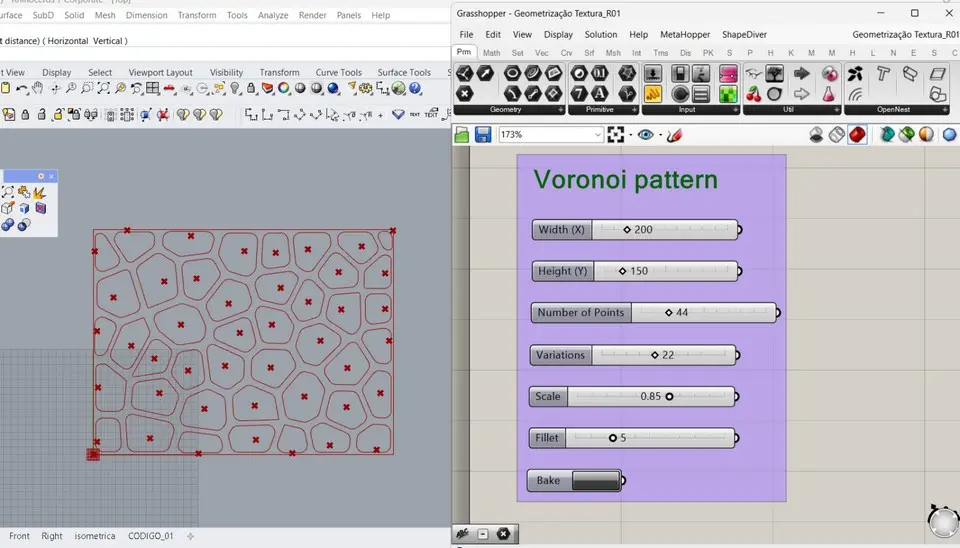
The adjustable parameters used to control the Voronoi pattern
A Simple and Flexible Grasshopper System
The Grasshopper workflow was intentionally kept simple and adaptive.
First, the script defines the panel boundaries. It then generates Voronoi cells based on point distribution. After that, the cells are scaled to create profiles between openings, softened with fillets, and then transferred into Rhino for further editing.
The main adjustable parameters include:
- panel dimensions;
- number of points;
- point distribution randomness;
- scaling factor;
- fillet radius.
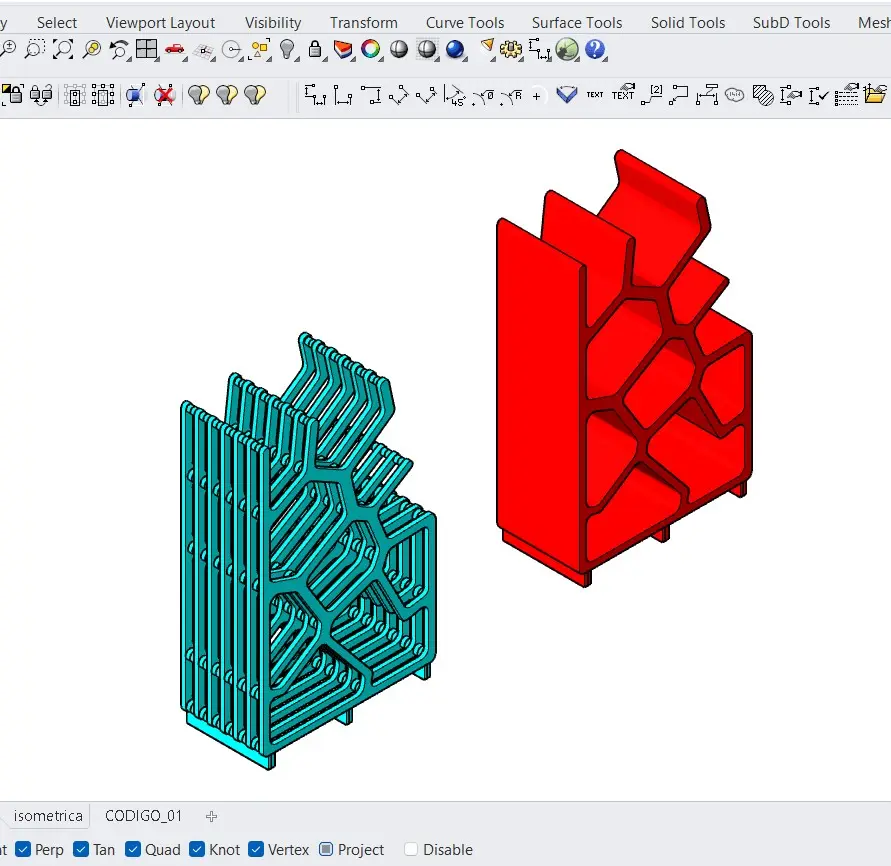
Comparison between the 3D-printed prototype version and the CNC-ready production file
From Microtexture to Furniture Object
Initially, the system was conceived as a microtexture generator.
The pattern could be developed as a vector tile, adapted into a seamless rapport, and applied to surfaces such as fabrics, panels, tiles, or lamps.
At this stage, one of the main challenges was to maintain continuity between the cells so that the base vector could repeat seamlessly across a larger surface. This adjustment was carried out directly in Rhino after transferring the geometry from Grasshopper.
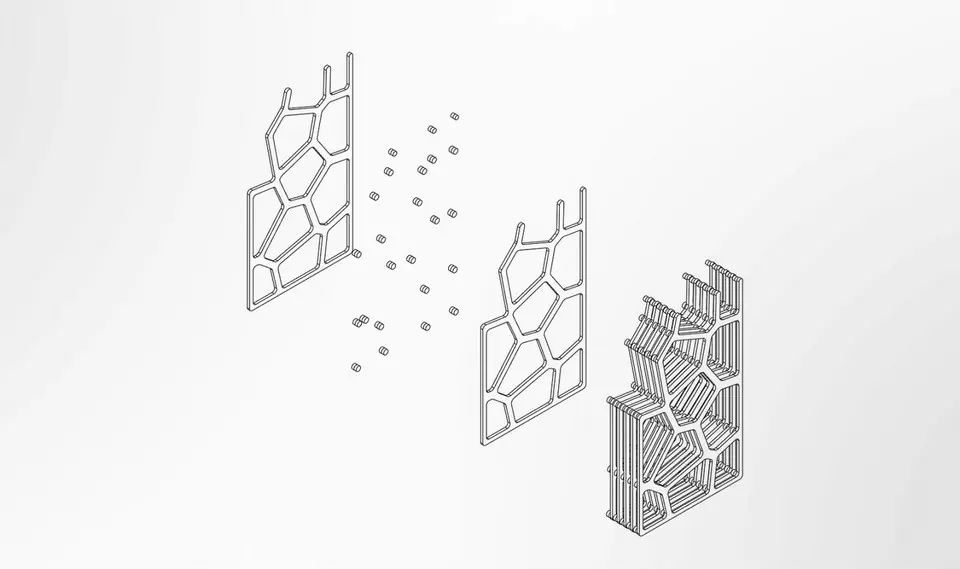
Exploded view showing the panels, spacers, and assembly logic of the shelf
But the most interesting stage came later, when the same definition was reinterpreted at a larger scale.
In a later academic project — a shelf for backpacks and shoes — the Voronoi logic was used to generate the geometry of a repeated side module. This gave the furniture piece depth and a strong visual identity.
What began as a microtexture started to work as a structural and compositional element.
New Constraints for Production
Moving to furniture scale introduced new production constraints.
Since the shelf was designed with CNC milling in mind, the geometry had to meet not only visual requirements but also the conditions of machinability, material strength, and structural stability.
Minimum thicknesses were adjusted, fragile areas were removed, and the balance between openwork and rigidity became an important part of the design process.
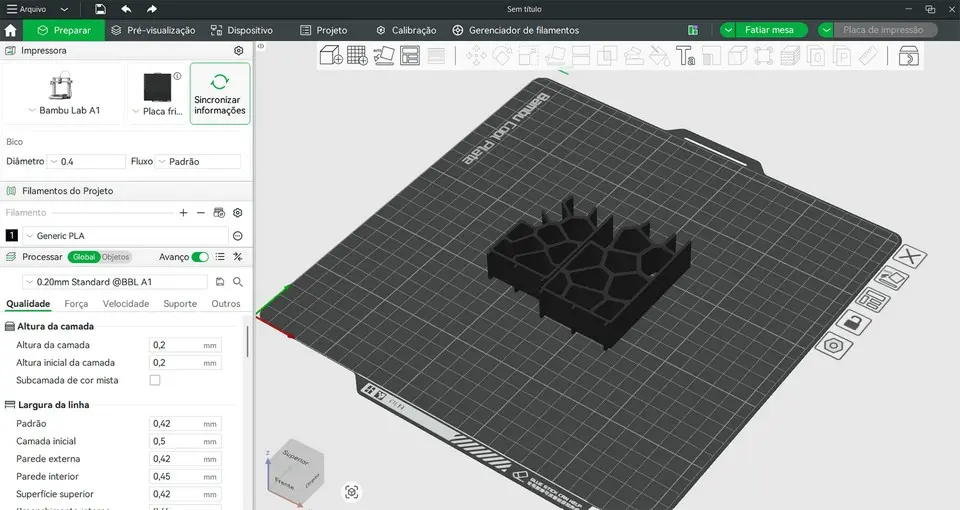
FDM 3D printing preparation of the shelving prototype in the slicer software
For the furniture object, fewer seed points were used to create larger openings suitable for storing backpacks and shoes.
At the same time, the scaling factor was increased to form a stronger structural frame.
The final design also considered the use of threaded rods and circular spacers to improve the rigidity of the structure. This approach had previously been explored in other parametric bench projects.
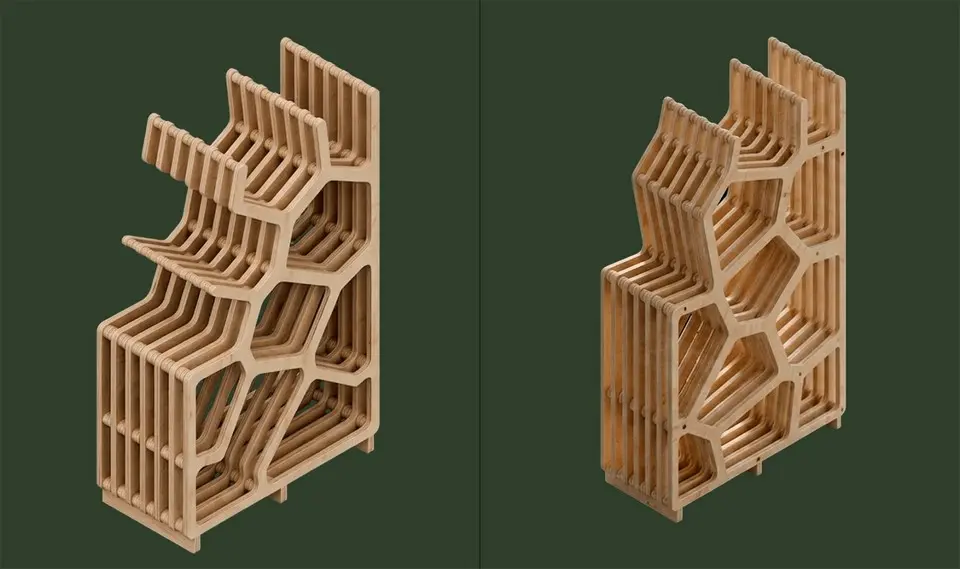
Two shelf variations generated from the same parametric Voronoi logic
Two Versions of One System
Two shelf versions were developed in the project.
The first was optimised for FDM 3D printing to simplify prototype fabrication.
The second was prepared for CNC machining and showed structural profiles and circular spacers through which threaded rods would pass in the final object.
This process clearly shows one of the strengths of parametric modelling: the ability to create systems that can evolve.
Instead of one fixed form, the Grasshopper definition became a flexible design logic. It was able to move from texture to product, from surface to structure, and from an academic experiment to fabrication-oriented design.
Credits
Project: From Texture to Furniture: The Evolution of a Parametric Definition
Designer: Ana Luisa Martins
Image Credits: Ana Luisa Martins
Explore Rhino and Grasshopper
This project shows how Rhino and Grasshopper can help designers move from early geometric experiments to fabrication-ready product concepts.
If you want to explore parametric modelling, biomimetic patterns, and flexible design workflows, Rhino provides a powerful environment for developing ideas from concept to production.
Explore Rhino 3D >>